
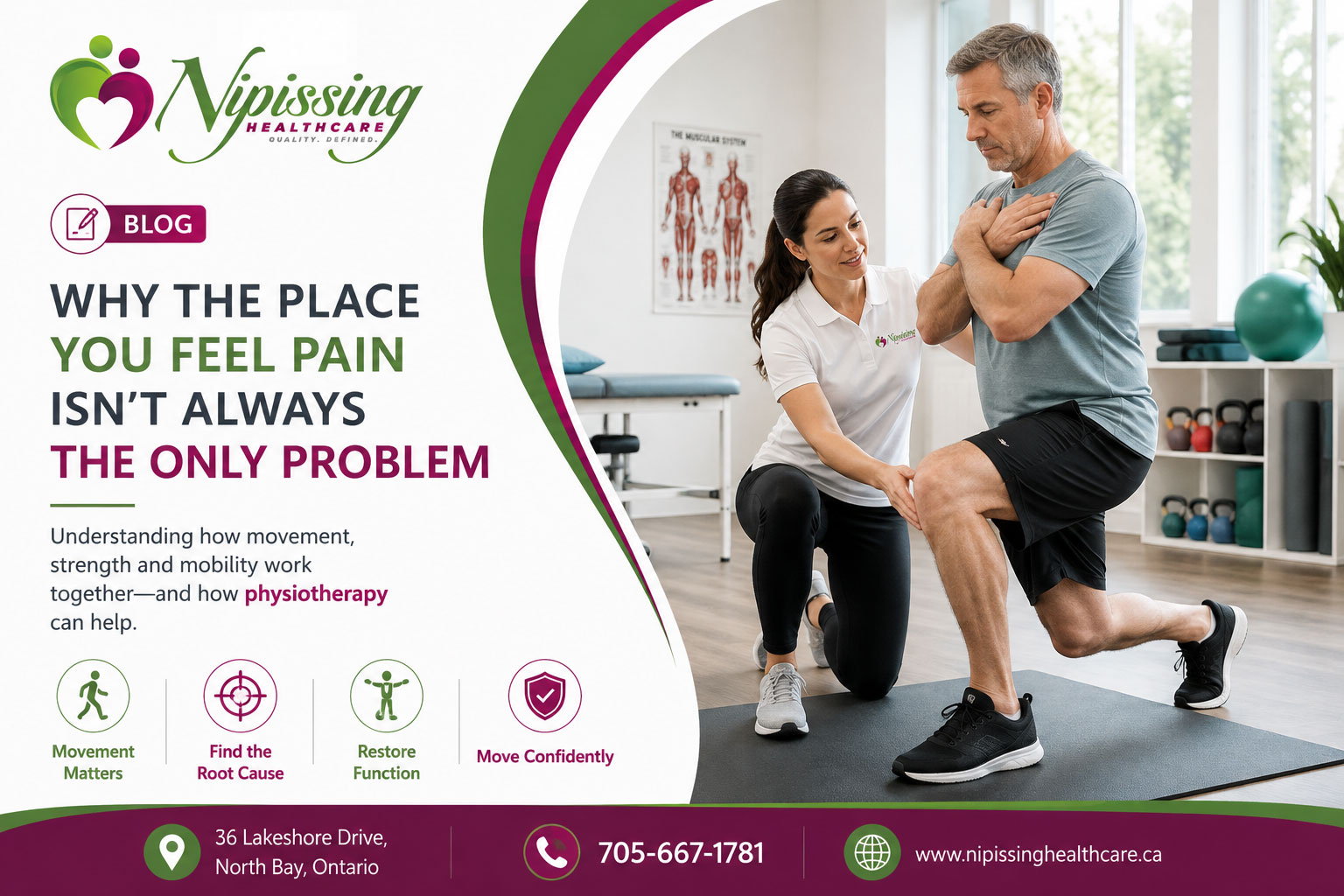
You feel pain in your knee.
So naturally, you think something is wrong with your knee.
Your shoulder hurts, so you focus on your shoulder.
Your lower back is sore, so you assume your back is the problem.
That makes sense. Pain tells us where something hurts.
But it doesn’t always tell us the whole story.
The way your body moves is connected. Your joints, muscles, balance, posture and movement patterns all work together when you walk, bend, reach, lift or climb stairs.
Sometimes the area that hurts is being affected by something happening somewhere else.
For example, weakness in one area can change the way you move. Limited mobility can cause you to compensate. An old injury can change your movement long after you think you’ve recovered.
This doesn’t mean that every painful area has a hidden problem somewhere else.
It simply means that looking only at the painful spot may not always provide the complete picture.
That is why a good physiotherapy assessment looks at how you move, not just where you hurt.
At Nipissing Healthcare, our evidence-based physiotherapy approach focuses on understanding movement, identifying contributing factors and developing rehabilitation around each person’s individual needs.
✅ Pain Is Important — But It Isn’t the Whole Story
Pain is one of the body’s most important warning signals.
But pain can be influenced by many different factors.
These may include:
- Joint movement
- Muscle strength
- Flexibility
- Previous injuries
- Repetitive movements
- Physical activity levels
- Posture
- Balance
- Coordination
- How the body compensates during movement
This is why two people can have similar pain but require completely different rehabilitation programs.
Someone with knee pain may have reduced hip strength.
Another person may have limited ankle mobility.
Someone else may be recovering from an old injury that has changed how they walk.
The pain may be in the same place.
The reason behind it may not be.
✅ Your Body Works as a System
Think about walking.
Your feet make contact with the ground.
Your ankles adjust.
Your knees bend.
Your hips control your movement.
Your pelvis and core help stabilize your body.
Your spine and upper body respond to each step.
Your brain coordinates all of it.
You don’t consciously think about each individual movement.
Your body simply does it.
But if one part of that system becomes weaker, stiffer or painful, other areas may begin compensating.
Sometimes those compensations are barely noticeable.
Other times, they eventually become part of the way you move.
✅ 1. An Old Injury Can Affect You Long After It Heals
You may have injured your ankle years ago.
The pain disappeared.
You went back to normal life.
But perhaps you never completely regained the same strength or movement.
You might unconsciously place more weight on the other leg when walking.
You might avoid certain movements.
You might turn your foot slightly differently.
None of these changes necessarily feel significant.
But movement patterns can become habits.
Over time, the body continues adapting to them.
This is one reason previous injuries are important when a physiotherapist assesses a new problem.
✅ 2. Muscle Weakness Can Change How You Move
Strength isn’t only about how much weight you can lift.
It helps control everyday movement.
Your muscles help you:
- Stabilize your joints
- Maintain balance
- Control your walking
- Climb stairs
- Get out of a chair
- Reach overhead
- Carry objects
- Change direction
If one muscle group isn’t doing its job effectively, another area may have to work harder.
This can change how a movement feels.
A physiotherapy assessment can identify strength differences and determine whether targeted strengthening could improve your overall movement.
✅ 3. Limited Mobility Can Lead to Compensation
Stiffness can change the way you move.
Consider your ankle.
If it doesn’t move comfortably when you walk, your body still has to find a way to move forward.
You may compensate through your knee, hip or other parts of your body.
The same principle can apply to your hips, spine, shoulders and other joints.
This is why improving mobility isn’t always about stretching one tight muscle.
The bigger question is:
How is that limitation affecting the way you move?
✅ 4. Your Body May Be Protecting an Area That Hurts
When something hurts, people naturally change how they move.
You might:
- Put less weight on one leg
- Avoid reaching with one arm
- Sit differently
- Walk more slowly
- Stop bending
- Change how you lift things
These adaptations can be helpful in the short term.
But if they continue for a long time, they can become part of your normal movement pattern.
This is one reason rehabilitation doesn’t stop at making pain feel better.
The goal is also to help you gradually return to healthier movement.
✅ 5. The Way You Move Matters More Than You Think
Two people can perform the same activity in completely different ways.
Take lifting a grocery bag.
One person may bend through their hips and knees.
Another may bend mostly through their back.
Neither movement necessarily tells us everything about the person’s health.
But if someone repeatedly performs an activity in a way that places unnecessary stress on a painful or recovering area, changing how they perform that movement may become an important part of rehabilitation.
Physiotherapy can help people understand their movement and develop better strategies for everyday activities.
✅ What Happens During a Physiotherapy Assessment?
A physiotherapy assessment isn’t simply:
“Where does it hurt?”
That question matters, but it is only the beginning.
Your physiotherapist may also look at:
- How you walk
- How you stand
- Joint mobility
- Muscle strength
- Balance
- Flexibility
- Coordination
- Posture
- Functional movements
- Previous injuries
- Activities that make symptoms better or worse
- Your daily routine
- Your rehabilitation goals
This broader picture helps your physiotherapist understand how your symptoms may be affecting your movement—and how your movement may be contributing to your difficulties
✅ Your Treatment Should Reflect Your Actual Life
A rehabilitation program shouldn’t exist only inside the clinic.
Your real goals might be much simpler.
You want to:
- Walk around the neighbourhood.
- Get back to gardening.
- Pick up your grandchildren.
- Return to the gym.
- Play your favourite sport.
- Climb stairs without hesitation.
- Get through your workday comfortably.
- Move around your home independently.
These goals matter.
A personalized physiotherapy program should connect treatment to the activities you actually want to return to.
✅ When Should You Consider a Physiotherapy Assessment?
You don’t necessarily need to wait until pain becomes severe.
Consider an assessment if you notice:
- Pain that keeps returning
- Reduced mobility
- Weakness
- Changes in walking
- Difficulty with stairs
- Recurring injuries
- Balance concerns
- Difficulty returning to exercise
- Pain affecting work or daily activities
- An old injury that continues to affect how you move
Early assessment can help you understand what’s happening before a movement problem becomes a larger limitation.
✅ Physiotherapy Isn’t About Finding One “Bad” Body Part
One of the most important things to understand about rehabilitation is that your body doesn’t work in isolated pieces.
Your physiotherapist isn’t necessarily looking for one muscle or joint to blame.
They’re looking at the relationship between different parts of your movement.
Sometimes the answer is straightforward.
Sometimes it takes more investigation.
And sometimes the best approach is simply helping you move more effectively while gradually rebuilding strength, mobility and confidence.
That individualized process is what makes physiotherapy different from simply treating a painful area.
✅ What You Can Pay Attention to at Home
You don’t need to diagnose yourself.
But you can become more aware of how your body moves.
Notice whether:
👉 You move differently on one side
Do you rely more heavily on one leg or arm?
👉 Certain movements are becoming harder
Are stairs, getting out of a chair or reaching overhead becoming more difficult?
👉 You avoid particular activities
Have you stopped doing something because you expect it to hurt?
👉 An old injury keeps coming back
Does the same area become uncomfortable whenever you increase activity?
👉 Your movement has changed
Are you walking differently or using support more often?
These observations can be useful information to share during a physiotherapy assessment.
✅ Supporting Better Movement in North Bay
At Nipissing Healthcare, we believe effective rehabilitation starts with understanding the individual.
Our evidence-based physiotherapy programs focus on movement, function, strength and mobility rather than simply treating a symptom in isolation.
Whether you’re recovering from an injury, managing a musculoskeletal condition, returning to activity, or experiencing changes in mobility, your rehabilitation program can be tailored to your needs and goals.
Serving North Bay and surrounding communities, Nipissing Healthcare is committed to helping people move with greater confidence and maintain their independence.
✅ Frequently Asked Questions
👉 Why does my knee hurt if the problem isn’t only in my knee?
Pain can be influenced by several factors, including strength, mobility, previous injuries and movement patterns. A physiotherapy assessment can help identify factors that may be contributing to your symptoms.
👉 Can physiotherapy help if I don’t know what is causing my pain?
Yes. Assessment is an important part of physiotherapy. Your physiotherapist can evaluate your movement, strength, mobility and functional limitations to help determine an appropriate rehabilitation approach.
👉 Can an old injury cause problems years later?
An old injury may continue to influence strength, mobility or movement patterns even after the original pain has resolved. This doesn’t mean the old injury is necessarily causing a current problem, but it can be relevant during assessment.
👉 Does physiotherapy only treat pain?
No. Physiotherapy can also focus on mobility, strength, balance, coordination, function, injury recovery and maintaining independence.
👉 When should I see a physiotherapist?
Consider an assessment when pain, weakness, stiffness, balance problems or changes in movement begin affecting your daily activities, exercise or quality of life.
✅ Conclusion
When something hurts, it’s natural to focus on the painful area.
But your body doesn’t work in isolation.
The way you walk can be influenced by your hips, knees, ankles, muscles and balance.
The way you reach can be influenced by your shoulder, spine and posture.
An old injury can change how you move long after the original pain has disappeared.
That doesn’t mean every problem has a complicated explanation.
It means your movement deserves to be looked at as a whole.
Physiotherapy can help you understand those movement patterns, identify areas that may need attention and build a rehabilitation plan around the way you actually want to live.
Because sometimes the most useful question isn’t only “Where does it hurt?”
It’s “What is happening when I move?”
✅ Book Your Physiotherapy Assessment
If pain, stiffness, weakness or changes in movement are affecting your everyday life, a physiotherapy assessment can help you understand what’s happening and what steps may help.
At Nipissing Healthcare, our evidence-based physiotherapy team provides personalized rehabilitation focused on movement, function and long-term independence.
Book an assessment and take the next step toward moving with greater confidence.
📍 36 Lakeshore Drive, North Bay, Ontario
☎ 705-667-1781
🌐 www.nipissinghealthcare.ca