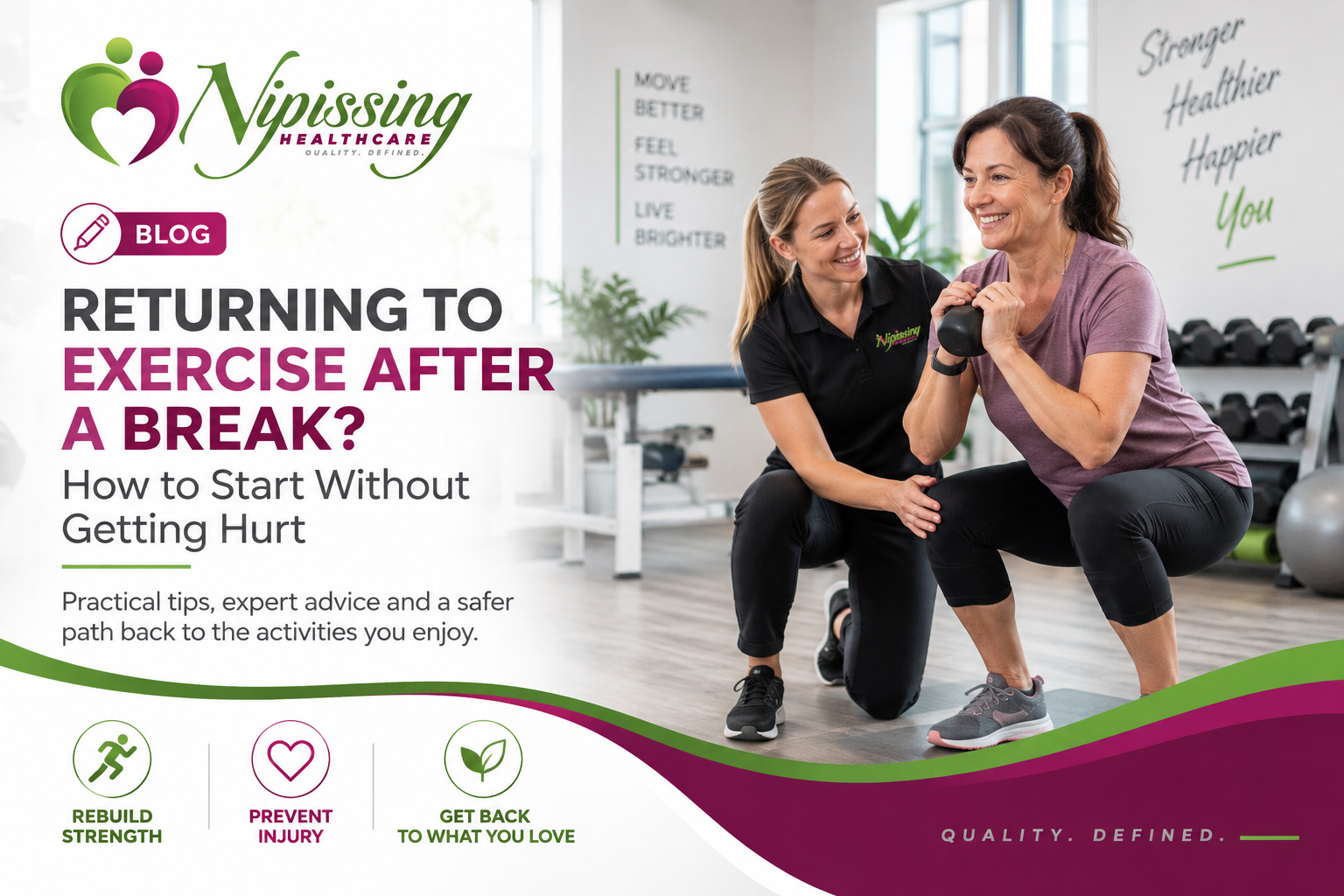
Getting back into exercise can feel surprisingly difficult.
You remember what you used to be able to do.
Maybe you used to run several kilometres without thinking about it. Maybe you played sports every weekend, went to the gym regularly, or simply had a routine of walking and strength training.
Then life got busy.
Work changed. Summer arrived. You travelled. You took some time off. An old injury became annoying. Or you simply stopped making exercise a priority.
Now you’re ready to start again.
The temptation is understandable:
Just pick up where you left off.
But your body may not be ready for the same workload it handled several months ago.
That doesn’t mean you’ve lost everything. It means your current capacity may be different from what it was when you were training consistently.
The safest way to return to exercise is usually not to push harder immediately. It’s to rebuild gradually.
Canadian guidance recommends regular physical activity for adults, including aerobic activity and muscle-strengthening activities. But the right starting point depends on your current fitness, health, previous injuries and the activity you’re returning to.
If you’ve had an injury or are experiencing pain or movement limitations, a physiotherapist can also help determine how to progress safely.
Quick Answer: How Should You Return to Exercise After a Break?
☑️ Short Answer
Start below your previous level and gradually increase the amount, intensity and complexity of exercise as your body adapts.
Don’t try to recreate your old routine during your first week back.
A sensible return usually involves:
- Starting with manageable activity.
- Rebuilding consistency.
- Reintroducing strength gradually.
- Increasing intensity only when your body is tolerating the workload.
- Paying attention to pain and unusual symptoms.
- Adjusting the plan when something isn’t going well.
Physical-therapy guidance similarly recommends adding new activity or increasing intensity, distance, speed or resistance gradually rather than doing too much too soon.
☑️ Key Takeaway
Your first goal isn’t to get back to your old performance.
It’s to build enough consistency that your body is ready for the next step
Understanding What Happens When You Take Time Off
Taking a break from exercise doesn’t mean your body suddenly becomes unhealthy.
But your tolerance for a particular workload can change.
If you’ve stopped running, for example, your cardiovascular fitness may be different, but so may the strength and tolerance of the muscles, tendons and joints involved in running.
The same applies to:
- Weight training
- Basketball
- Hockey
- Cycling
- Hiking
- Swimming
- Recreational sports
- High-intensity workouts
The important distinction is between being able to perform a movement and being prepared to tolerate a large amount of that movement repeatedly.
☑️ What Is Exercise Tolerance?
Exercise tolerance is essentially how much physical activity your body can comfortably handle at a particular point in time.
It depends on factors such as:
- Current fitness
- Strength
- Endurance
- Mobility
- Previous injuries
- Recovery
- Sleep
- Activity level
- The demands of the activity
After time away, your current tolerance may be lower than your previous training level.
That’s why a gradual return makes sense.
☑️ Why Does This Matter?
Imagine you haven’t run for four months.
On your first day back, you run the same distance and pace you used to manage comfortably.
Your cardiovascular system may tolerate the session reasonably well.
But your calves, Achilles tendon, knees, hips or other tissues may not be accustomed to that workload anymore.
The issue isn’t necessarily the activity itself.
It may simply be too much, too soon.
The Main Problem: Trying to Do Too Much Too Soon
One of the most common mistakes when returning to exercise is trying to prove that you can still do what you used to do.
You remember your old weights.
Your old running pace.
Your old workout duration.
So you start there.
Then soreness appears.
Or your knee starts hurting.
Or your back feels tight.
Or an old injury returns.
This is where a gradual progression becomes important.
☑️ Your Previous Fitness Level Isn’t Your Current Starting Point
Your previous ability is useful information.
It tells you what you’ve achieved before.
But it doesn’t necessarily tell you what your body is ready to handle today.
Think of your previous level as a destination rather than your starting point.
☑️ Soreness Isn’t Always the Same as Injury
Some muscle soreness can occur after returning to unfamiliar or more demanding activity.
But pain that is severe, persistent, worsening, associated with swelling, instability, significant weakness, or causing you to change how you move should not simply be pushed through.
If you’re unsure whether what you’re experiencing is normal exercise soreness or something that needs assessment, professional guidance can help.
☑️ Common Misconception: “No Pain, No Gain”
Exercise does not need to hurt to be effective.
Discomfort and effort can be part of challenging your body, but significant or worsening pain isn’t something you need to accept as the price of getting fit.
A better goal is:
Challenge the body enough to adapt without overwhelming its current capacity.
What Actually Works When Returning to Exercise
☑️ Strategy 1: Start With Less Than You Think You Can Do
Your first few sessions should feel manageable.
That may mean:
- Walking instead of running
- Using lighter weights
- Reducing workout duration
- Taking longer recovery periods
- Performing fewer repetitions
- Choosing simpler movements
This isn’t taking exercise “too easy.”
It’s creating room for progression.
☑️ Strategy 2: Rebuild Consistency Before Intensity
A common mistake is having one excellent workout followed by several days of soreness.
Instead, aim for consistency.
A moderate workout you can repeat is generally more useful than an extremely hard workout that leaves you unable to train again for several days.
☑️ Strategy 3: Rebuild Strength
Strength training can be particularly useful when returning to activities that place higher demands on the body.
Depending on the activity, strengthening may involve:
- Legs
- Hips
- Core
- Back
- Shoulders
- Arms
- Calves
- Sport-specific muscles
Canadian physical-activity recommendations include muscle- and bone-strengthening activities as part of a healthy activity pattern for adults.
☑️ Strategy 4: Reintroduce Your Activity Gradually
Don’t bring everything back at once.
If you’ve taken several months away from exercise, you might reintroduce:
Frequency → Duration → Intensity → Complexity
rather than increasing everything simultaneously.
For example, someone returning to running might first establish comfortable walking and short run intervals before gradually increasing running duration.
Someone returning to the gym might begin with familiar movements at lower resistance before progressing toward previous loads.
✍️ Practical Step-by-Step Approach to Getting Back Into Exercise
☑️ Step 1: Identify Where You Are Now
Before starting, ask yourself:
- How active have I been recently?
- Have I had any injuries?
- Do I have current pain?
- Has my strength changed?
- How is my balance?
- How easily can I perform everyday movements?
- What activity am I trying to return to?
Your answers help determine a realistic starting point.
☑️ Step 2: Choose a Manageable Version of Your Activity
You don’t have to immediately perform the full version.
Examples:
Running:
Walk → walk/jog intervals → easy running → longer running
Strength training:
Bodyweight → light resistance → moderate resistance → previous training load
Sports:
Individual drills → low-intensity practice → controlled play → full participation
Hiking:
Short, easier route → longer route → more elevation → more demanding terrain
The exact progression should reflect the individual and the activity.
☑️ Step 3: Give Your Body Time to Adapt
Your body needs recovery between challenging sessions.
Pay attention to how you feel not only during exercise but later that day and the following day.
If a particular increase consistently causes a flare-up, that information is useful.
It may mean the progression needs to be adjusted.
☑️ Step 4: Build Toward Your Actual Goal
Your final goal determines what you should train for.
If you want to return to:
- Running
- Hockey
- Golf
- Tennis
- Hiking
- Weight training
- Cycling
your rehabilitation or conditioning should eventually reflect the movements and demands of that activity.
General fitness is valuable, but specific activities also require specific preparation.
✍️ Common Mistakes to Avoid
☑️ Mistake 1: Starting at Your Old Intensity
Your old workout may have been appropriate for your old fitness level.
It may not be appropriate for your current one.
Start lower and earn your way back.
☑️ Mistake 2: Increasing Everything at Once
Increasing frequency, duration, speed and resistance simultaneously makes it difficult to know what your body is reacting to.
Progress one element at a time when possible.
☑️ Mistake 3: Ignoring a Recurring Pain
If the same pain appears every time you return to a particular activity, don’t keep restarting the same cycle.
Something about the workload, movement, strength, recovery or underlying condition may need attention.
☑️ Mistake 4: Treating Rest as Failure
Recovery is part of training.
Taking a rest day doesn’t mean you’re losing progress.
It gives your body an opportunity to adapt to the work you’ve already done.
✍️ Returning to Exercise in North Bay
North Bay offers plenty of opportunities to stay active, from walking and outdoor recreation to organized sports and gym-based exercise.
The challenge isn’t finding an activity.
It’s finding a sustainable way to return to it.
For recreational athletes, active adults and people simply trying to become more physically active, a gradual approach can help make exercise something you can maintain rather than something you repeatedly start and stop.
At Nipissing Healthcare, physiotherapy supports people recovering from injuries, surgery and chronic conditions, while the clinic’s service offering also includes sports and injury recovery and strength and mobility restoration.
That makes physiotherapy relevant not only after an injury, but also when an existing physical limitation is preventing someone from safely returning to the activities they value.
✍️ AEO Quick Answers
☑️ How do I start exercising again after a long break?
Start below your previous training level and gradually increase duration, resistance, intensity or complexity as your body adapts. Avoid trying to reproduce your old workout immediately.
☑️ How long should I take it easy after not exercising?
There is no single timeline that applies to everyone. Your starting point depends on how long you’ve been inactive, your current fitness, previous injuries and the activity you’re returning to.
☑️ Why do I get sore when I start exercising again?
New or increased activity can cause muscle soreness because your body is adapting to a workload it hasn’t experienced recently. Persistent, severe or worsening pain is different and may warrant professional assessment.
☑️ Can I go back to my old workout routine immediately?
It is generally better to rebuild gradually. Your previous fitness level does not necessarily reflect your current tolerance for exercise.
☑️ How quickly should I increase exercise?
Increase gradually rather than making large jumps in duration, intensity, distance, speed or resistance. Your response to the current workload should guide the next progression.
☑️ Should I stretch before exercising?
A warm-up involving easier versions of the movements you’re about to perform can help prepare you for activity. Stretching may be useful in some situations, but it should not be treated as the only injury-prevention strategy.
☑️ Can physiotherapy help me return to sports?
Yes. Physiotherapy can assess strength, mobility, movement and functional limitations and develop progressive rehabilitation or conditioning appropriate to your goals. Nipissing Healthcare specifically lists sports and injury recovery among its physiotherapy services.
☑️ When should I see a physiotherapist before returning to exercise?
Consider professional assessment if you have persistent pain, a previous injury that keeps returning, significant weakness, reduced mobility, balance concerns, or uncertainty about how to safely progress your activity.
✍️ Practical Checklist
☑️ Before You Start
➔ Decide what activity you want to return to.
➔ Consider how active you’ve been recently.
➔ Identify any current pain or previous injuries.
➔ Start below your previous training level.
➔ Choose a realistic first session.
➔ Make sure you have appropriate footwear and equipment.
☑️ During the Process
➔ Warm up progressively.
➔ Focus on movement quality.
➔ Increase workload gradually.
➔ Avoid increasing several training variables at once.
➔ Pay attention to unusual or worsening pain.
➔ Give your body adequate recovery.
☑️ Measuring Progress / Results
Don’t measure your return only by how much weight you can lift or how fast you can run.
Look at:
- How consistently you can exercise
- How well you recover
- Whether movement feels comfortable
- Whether strength is improving
- Whether your endurance is improving
- Whether you can perform your activity with confidence
- Whether you’re able to increase workload without recurring symptoms
Progress should be sustainable.
✍️ When Professional Help Makes Sense
☑️ Why Expertise Matters
Sometimes the problem isn’t motivation.
You want to exercise.
You simply aren’t sure how to get back to it.
This is especially common after an injury, surgery, prolonged inactivity or repeated episodes of pain.
A physiotherapist can assess factors such as:
- Strength
- Mobility
- Balance
- Movement patterns
- Functional capacity
- Previous injuries
- Activity-specific demands
This can help determine what needs to improve before you increase the workload.
☑️ When Personalised Support Is Useful
Professional guidance can be particularly useful if:
- Pain keeps returning when you exercise
- You are recovering from surgery
- An old injury is limiting your activity
- You have significant weakness
- Your mobility has changed
- You are unsure how much exercise is appropriate
- You want to return to a sport after injury
- You have tried returning several times and keep getting setbacks
Nipissing Healthcare’s physiotherapy service includes sports and injury recovery, post-surgical rehabilitation, chronic pain management, and strength and mobility restoration, making these natural areas for the clinic to support.
✍️ Conclusion
Getting back into exercise doesn’t have to mean proving that you can still do what you used to.
It means giving your body the opportunity to build back toward it.
Start where you are.
Move consistently.
Build strength.
Increase the workload gradually.
Pay attention to how your body responds.
And don’t ignore recurring problems simply because you want to stay active.
For many people, returning to exercise is less about one perfect workout and more about building a routine that the body can actually tolerate and maintain.
You don’t need to start where you left off.
You just need to start at the right level for where you are today.
✍️ Call to Action
☑️ Get Back to the Activities You Enjoy
If pain, an old injury, weakness or reduced mobility is making it difficult to return to exercise, a physiotherapy assessment can help you understand what is limiting your movement and how to progress safely.
At Nipissing Healthcare, rehabilitation is personalized around your condition, activity level and goals.
Whether you’re returning to recreational exercise, recovering from an injury, or rebuilding strength and mobility, our physiotherapy team can help you work toward a confident return to activity.
Book an assessment and take the next step toward getting back to the activities you enjoy.
Nipissing Healthcare
🌐 36 Lakeshore Drive North Bay, Ontario
☎ 705-667-1781
📍 www.nipissinghealthcare.ca