
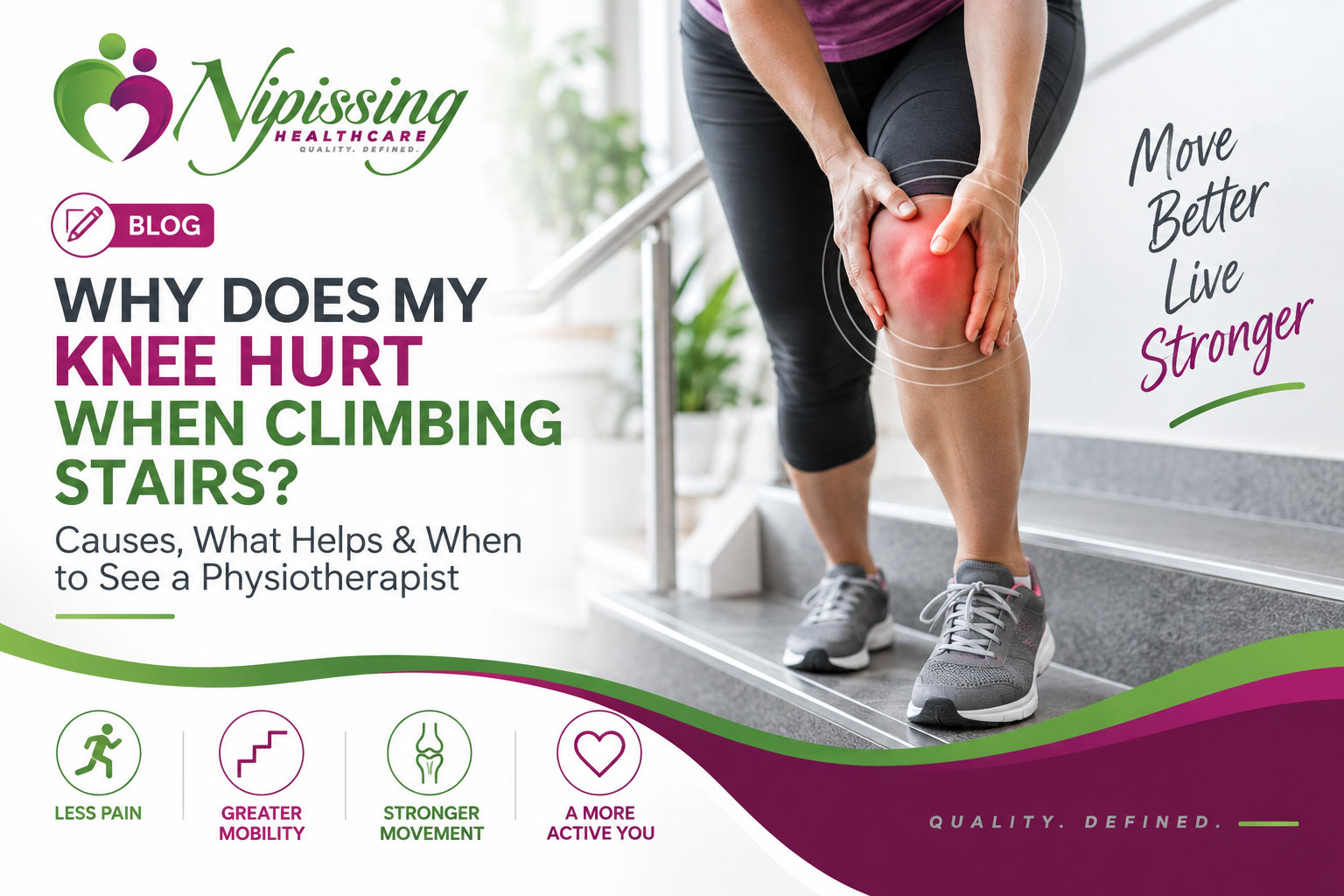
Climbing stairs is something most people do without giving it much thought—until the movement starts causing knee pain.
You may notice discomfort when taking the first few steps, pain around the kneecap, stiffness after sitting, or a sharper sensation when going downstairs. Sometimes the problem appears only during stairs, while walking on level ground feels completely normal.
Knee pain during stair climbing does not automatically mean that your knee is damaged or that you have arthritis. Several different factors can contribute, including joint irritation, muscle weakness, changes in movement mechanics, previous injuries, overuse and conditions such as patellofemoral pain or osteoarthritis.
Understanding why your knee hurts during a specific movement is often more useful than simply trying to avoid that movement.
☑️ Quick Answer: Why Does My Knee Hurt When Climbing Stairs?
❣️ Short Answer
Knee pain when climbing stairs can have several causes, including muscle weakness, changes in how the hip and knee move, joint stiffness, overuse, previous injury, patellofemoral pain or knee osteoarthritis.
Stair climbing places a greater functional demand on the muscles and joints of the lower limb than ordinary level walking. If the knee, hip, ankle or surrounding muscles are not working efficiently together, certain movements may become painful.
A physiotherapy assessment can help identify which factors may be contributing to your symptoms rather than assuming that the pain is coming from the knee joint alone.
❣️ Key Takeaway
Pain while climbing stairs is a symptom, not a diagnosis.
The location and timing of your pain, what movements make it worse, your strength and mobility, previous injuries and your overall activity level all help determine what may be contributing to the problem.
☑️ Understanding Knee Pain When Climbing Stairs
❣️ What Is Knee Pain During Stair Climbing?
Knee pain during stair climbing refers to discomfort that appears while stepping upward or downward, particularly when bending and loading the knee.
You may experience:
- Pain around or behind the kneecap
- Pain at the front of the knee
- Pain on the inside or outside of the knee
- Stiffness when bending the knee
- Pain when stepping down
- Pain when squatting or sitting down
- Weakness or a feeling that the knee is not supporting you properly
The specific pattern matters because different knee conditions can produce different symptoms.
For example, patellofemoral pain can be associated with activities such as climbing stairs, squatting and running, while osteoarthritis may cause pain and stiffness during activities such as walking, stair climbing or getting up from a chair.
❣️ Why Does Stair Climbing Matter?
Stairs are a useful example of functional movement because they require coordinated movement through the hip, knee and ankle.
Your body needs to:
- Control the knee as it bends
- Produce enough strength to move your body upward
- Control your body weight while stepping down
- Maintain balance
- Coordinate the hip, knee and ankle
- Adapt to the height and speed of the steps
If one part of this system is not functioning efficiently, another area may compensate.
This is one reason why a physiotherapy assessment may examine more than just the painful knee.
☑️ The Main Question: What Could Be Causing Your Knee Pain on Stairs?
❣️ Muscle Weakness Can Affect How You Move
The muscles around your hip and knee play an important role in controlling lower-limb movement.
Weakness or reduced muscle capacity may make activities such as stair climbing, squatting or rising from a chair more difficult.
This does not mean that weak muscles are always the cause of knee pain. Rather, strength is one factor that a physiotherapist may assess alongside mobility, movement patterns and other symptoms.
❣️ Knee Stiffness or Reduced Mobility Can Change Movement
A knee that does not move comfortably through its available range can affect everyday activities.
You may compensate by changing how you bend the knee, shift your weight or use the surrounding joints.
Hip, ankle and foot mobility can also influence lower-limb movement, which is why a comprehensive assessment may look beyond the exact location where you feel pain.
❣️ Common Misconception: Knee Pain Automatically Means Arthritis
Not necessarily.
Knee pain can develop from many different causes, including injury, overuse, patellofemoral pain, osteoarthritis and other musculoskeletal conditions.
Age can be associated with an increased likelihood of osteoarthritis, but experiencing knee pain on stairs does not by itself establish an arthritis diagnosis.
A proper assessment is more useful than trying to diagnose yourself based on one symptom.
☑️ What Actually Helps Knee Pain During Stair Climbing?
❣️ 1. Understand What Triggers Your Symptoms
Start by paying attention to the pattern.
Ask yourself:
- Does the pain happen going up, going down, or both?
- Is it around the kneecap or elsewhere?
- Does walking cause the same pain?
- Does squatting reproduce it?
- Does the knee feel stiff?
- Is there swelling?
- Did the symptoms begin after an injury?
- Has your activity level recently changed?
These details can help a healthcare professional understand what is happening.
❣️ 2. Build Strength Progressively
Strengthening exercises are commonly used in rehabilitation because stronger and better-conditioned muscles can help support functional movement.
The appropriate exercises depend on the individual.
A rehabilitation program may progressively work on areas such as:
- Quadriceps strength
- Hip strength
- Lower-limb control
- Functional strength
- Balance
- Movement coordination
For people with knee osteoarthritis, clinical guidance recommends therapeutic exercise tailored to the individual’s needs, including muscle strengthening and aerobic fitness.
❣️ 3. Improve Movement Control
Strength alone is not the entire picture.
A person may have adequate strength but still experience difficulty controlling the knee during a squat, step-down or stair movement.
Physiotherapy may therefore focus on how you move as well as how strong you are.
Movement retraining can involve practising functional movements and progressively increasing the challenge as your ability improves.
❣️ 4. Manage Activity Instead of Completely Stopping
If a particular activity aggravates your symptoms, completely avoiding movement may not always be the best long-term strategy.
For many musculoskeletal problems, the goal is to find an appropriate level of activity and gradually build capacity rather than repeatedly pushing through significant pain or becoming completely inactive.
The appropriate approach depends on the underlying problem, symptom severity and individual circumstances.
For osteoarthritis, clinical guidance specifically recommends regular, tailored therapeutic exercise rather than inactivity.
☑️ Practical Guide: What to Do If Your Knee Hurts on Stairs
❣️ Step 1: Identify the Pattern
Notice exactly when the pain occurs.
Going up stairs and going down stairs can place different demands on movement control, so this distinction is useful.
Also note whether the pain occurs during:
- Squatting
- Lunging
- Walking
- Running
- Getting out of a chair
- Standing for long periods
❣️ Step 2: Temporarily Adjust the Load
If repeated stair climbing clearly aggravates your symptoms, consider reducing unnecessary repetition while maintaining comfortable movement.
For example, you may temporarily modify your activity rather than repeatedly performing a movement that causes significant discomfort.
This does not mean avoiding stairs forever.
The goal is to manage the current load while working toward improved capacity.
❣️ Step 3: Rebuild Strength and Mobility
Once the contributing factors are understood, rehabilitation can progressively address strength, mobility and movement control.
The exercises should match your current ability rather than simply copying an exercise routine found online.
Progression is important.
An exercise that is appropriate at one stage of rehabilitation may be too easy or too demanding at another stage.
❣️ Step 4: Reintroduce Functional Activities
As symptoms and physical capacity improve, rehabilitation should move toward the activities that matter in everyday life.
That might include:
- Climbing stairs
- Walking longer distances
- Squatting
- Getting in and out of a chair
- Returning to recreational activities
- Returning to sport
The objective is not simply to make the knee feel better while sitting.
It is to help restore useful movement and function.
☑️ Common Mistakes to Avoid
❣️ Mistake 1: Assuming the Pain Tells You Exactly What Is Wrong
Pain location can provide useful information, but it does not always identify the exact structure causing the problem.
Knee symptoms can have multiple contributing factors, which is why assessment matters.
❣️ Mistake 2: Stopping All Exercise
Avoiding all movement because your knee hurts can contribute to reduced strength and conditioning.
For many knee problems, appropriate movement and progressive exercise are important parts of rehabilitation.
The right level of activity depends on the individual condition.
❣️ Mistake 3: Doing Random Knee Exercises
An exercise that helps one person may not be appropriate for another.
The better approach is to understand what is contributing to the problem and choose exercises accordingly.
❣️ Mistake 4: Ignoring Persistent or Worsening Symptoms
A knee problem that repeatedly interferes with walking, stairs, work, exercise or sleep deserves attention.
Seek appropriate medical assessment if symptoms are persistent, worsening or significantly affecting normal activities.
Urgent assessment is particularly important if the knee is severely painful, cannot bear weight, is badly swollen or deformed, locks, gives way, or becomes hot and red with fever or feeling unwell.
☑️ Knee Pain and Physiotherapy in North Bay
❣️ Why a Functional Assessment Matters
If knee pain appears specifically when climbing stairs, a physiotherapist can look at the movement that produces your symptoms rather than focusing only on the painful area.
An assessment may consider:
- Knee range of motion
- Muscle strength
- Hip and lower-limb strength
- Walking pattern
- Balance
- Squatting
- Step or stair movement
- Previous injuries
- Activity levels
- Functional goals
Physical therapists commonly assess the knee alongside surrounding areas such as the hip, thigh, ankle and foot when investigating knee problems.
❣️ Physiotherapy for Knee Pain in North Bay
At Nipissing Healthcare, physiotherapy is focused on restoring mobility, strength and function through personalized rehabilitation plans.
The clinic’s physiotherapy services include sports and injury recovery, chronic pain management, post-surgical rehabilitation, and strength and mobility restoration.
For someone experiencing knee pain during stairs, the appropriate rehabilitation approach depends on the individual’s symptoms, physical findings, history and goals.
❣️ Why does my knee hurt when climbing stairs?
Knee pain when climbing stairs can be related to several factors, including muscle weakness, changes in movement mechanics, joint stiffness, overuse, previous injury, patellofemoral pain or osteoarthritis. A clinical assessment is needed to determine the likely contributors.
❣️ Why does my knee hurt more going down stairs?
Going downstairs requires controlled bending and lowering of the body. Pain during this movement can occur with several knee conditions, including patellofemoral pain and osteoarthritis. The exact cause depends on the individual’s symptoms and examination findings.
❣️ Is knee pain when climbing stairs a sign of arthritis?
It can be associated with knee osteoarthritis, but stair-related knee pain does not automatically mean you have arthritis. Other conditions can cause similar symptoms, so a proper assessment is more reliable than self-diagnosis.
❣️ Can weak muscles cause knee pain on stairs?
Muscle weakness can contribute to difficulty controlling the lower limb during functional activities. However, weakness is only one possible factor and should be considered alongside mobility, movement patterns, injury history and other symptoms.
❣️ What exercises help knee pain when climbing stairs?
The most appropriate exercises depend on the cause of the knee pain. Rehabilitation may include progressive strengthening, mobility work, balance training and functional movement exercises. Therapeutic exercise should be tailored to the individual’s condition and abilities.
❣️ Should I stop climbing stairs if my knee hurts?
Not necessarily. Completely avoiding activity is not always the best long-term approach. Depending on the cause and severity of symptoms, activity may be modified while strength, mobility and tolerance are progressively rebuilt.
❣️ Can physiotherapy help knee pain?
Yes. Physiotherapy can help assess contributing movement and strength factors and develop a personalized rehabilitation program aimed at improving pain, mobility and function.
❣️ When should I see a physiotherapist for knee pain?
Consider professional assessment when knee pain persists, repeatedly returns, limits daily activities or affects walking, stairs, exercise or sport. Urgent medical assessment is appropriate for severe pain, significant swelling, inability to bear weight, deformity, locking, or a hot, red knee accompanied by fever or feeling unwell.
☑️ Practical Checklist
❣️ Before You Start
Ask yourself:
- When does my knee hurt?
- Is it worse going up or down stairs?
- Did the symptoms begin after an injury?
- Is there swelling?
- Is my knee stiff?
- Has my activity level recently changed?
- Does squatting or walking also cause symptoms?
- Is the problem affecting daily life?
❣️ During the Process
Focus on:
- Appropriate activity levels
- Gradual progression
- Strength development
- Mobility
- Movement control
- Consistency
- Monitoring symptom response
Avoid repeatedly pushing through significant pain simply because you want to progress faster.
❣️ Measuring Progress and Results
Progress is not only about whether the pain disappears.
Useful measures can include:
- Climbing stairs more comfortably
- Walking farther
- Improved strength
- Better knee mobility
- Improved confidence
- Returning to exercise
- Returning to sport
- Completing everyday activities more easily
Functional improvement is an important part of rehabilitation.
☑️ When Professional Help Makes Sense
❣️ Why Expertise Matters
Knee pain can be surprisingly difficult to understand from symptoms alone.
Two people may both say, “My knee hurts on the stairs,” while having very different contributing factors.
A physiotherapy assessment can look at the complete movement system, including strength, mobility, balance, walking and functional movement.
This can help create a rehabilitation plan based on the person’s actual presentation rather than a generic list of exercises.
❣️ When Personalised Support Is Useful
Professional guidance can be particularly useful when:
- Pain keeps returning
- Symptoms are limiting normal activities
- You have difficulty climbing stairs
- You are returning to sport
- You have a history of knee injury
- You have ongoing stiffness
- You have reduced strength
- You are recovering after surgery
- You are unsure which exercises are appropriate
Nipissing Healthcare provides personalized physiotherapy focused on restoring strength, mobility and function, including sports and injury recovery and musculoskeletal rehabilitation in North Bay.
☑️ Conclusion
Knee pain when climbing stairs is common, but it should not automatically be dismissed as something that comes with age or assumed to be arthritis.
The pain may be influenced by strength, mobility, movement control, previous injury, activity levels or an underlying knee condition.
The most useful approach is to understand why the movement is painful, address the contributing factors and progressively rebuild the strength and movement capacity needed for everyday activities.
If your knee pain continues to interfere with stairs, walking, exercise or daily life, a physiotherapy assessment can help identify the factors contributing to the problem and determine an appropriate rehabilitation approach.
❣️ Move With Greater Confidence
If knee pain is making stairs, walking, exercise or everyday movement more difficult, consider having the problem assessed rather than simply working around it.
Nipissing Healthcare provides evidence-based physiotherapy and personalized rehabilitation in North Bay, Ontario, with a focus on restoring strength, mobility and function.
Nipissing Healthcare
📍 36 Lakeshore Drive North Bay, Ontario
☎ 705-667-1781
Contact Nipissing Healthcare to discuss a physiotherapy assessment.
👉 Strength and Mobility Restoration