
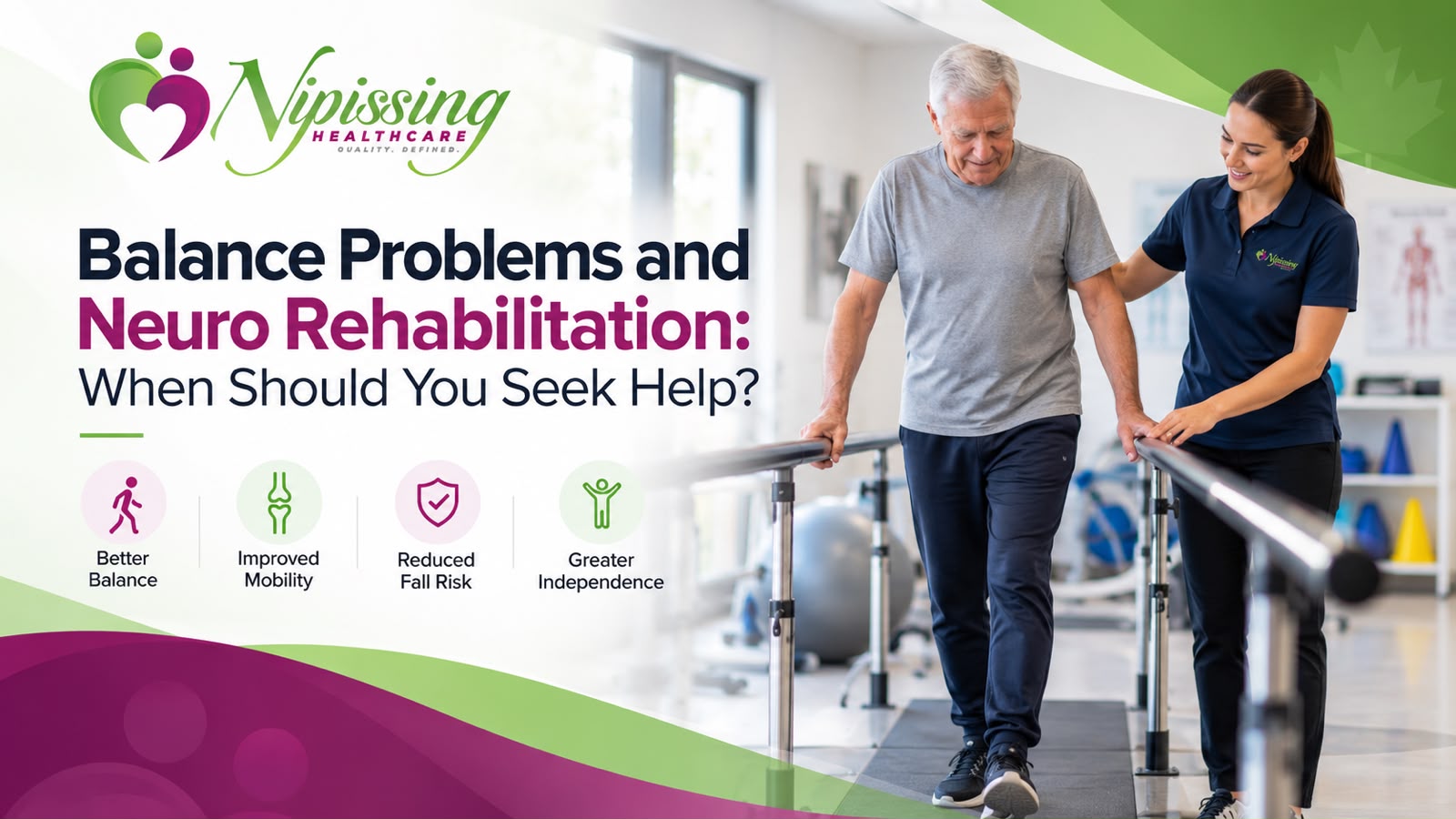
Balance is something most people rarely think about until it becomes difficult.
Feeling unsteady while walking, needing to hold onto furniture, struggling on stairs, or feeling less confident when moving around can affect everyday life. Balance problems can also increase the risk of falls and make people avoid activities they previously enjoyed.
The important point is that balance difficulties are not always simply a normal part of getting older.
Changes in strength, coordination, sensation, walking ability, or neurological function can all affect balance. Depending on the underlying cause, physiotherapy or neuro rehabilitation in North Bay may help improve movement, stability, confidence and functional independence.
At Nipissing Healthcare, our clinic provides physiotherapy and neuro rehabilitation focused on mobility, functional recovery and personalized patient care in North Bay, Ontario.
✍️ Quick Answer: When Should You Seek Help for Balance Problems?
✅ Short Answer
You should consider professional assessment if balance problems are persistent, worsening, affecting your daily activities, or making you afraid of falling.
Balance difficulties may be associated with weakness, reduced coordination, changes in walking pattern, neurological conditions, previous injury or other health concerns.
A physiotherapy or neuro rehabilitation assessment can help determine which aspects of movement and function need attention.
✅ Key Takeaway
Recurring balance problems should not simply be ignored.
If you are experiencing repeated unsteadiness, difficulty walking, changes in coordination or reduced confidence with movement, an assessment can help identify appropriate rehabilitation strategies.
✍️ Understanding Balance Problems
✅ What Causes Balance Problems?
Balance depends on several systems working together.
Your brain, muscles, joints, eyes and inner-ear balance system all contribute to your ability to remain stable while standing and moving.
A problem affecting one or more of these systems can change your balance.
Common contributing factors can include:
- Muscle weakness
- Reduced joint mobility
- Changes in sensation
- Poor coordination
- Changes in walking pattern
- Previous injury
- Neurological conditions
- Reduced physical activity
- Previous falls
- Age-related changes in strength and mobility
The underlying cause matters because treatment should be based on the individual’s specific needs.
✅ Why Can Balance Problems Affect Independence?
Balance is closely connected to everyday movement.
Simple activities such as:
- Getting out of a chair
- Walking across a room
- Using stairs
- Getting in and out of a vehicle
- Turning while walking
- Walking outdoors
- Carrying everyday items
can become more difficult when stability is reduced.
Over time, people may begin avoiding activities because they are worried about falling.
This can lead to less activity, further loss of strength and reduced confidence.
✍️ 7 Signs Your Balance May Need Professional Assessment
1. You Frequently Feel Unsteady
Occasional instability can happen to anyone.
However, frequent or unexplained unsteadiness deserves attention, particularly if it is affecting your ability to walk safely.
2. You Hold Onto Furniture While Walking
Needing walls, furniture or another person for support can indicate that your balance or mobility has changed.
An assessment can help identify whether strength, coordination, gait or another factor is contributing.
3. You Have Difficulty Walking on Uneven Surfaces
Uneven ground, curbs, grass and outdoor surfaces require your body to constantly adjust its position.
Difficulty adapting to these surfaces can increase instability.
4. Stairs Have Become More Difficult
Difficulty going up or down stairs can be associated with reduced leg strength, balance, coordination or confidence.
5. You Have Experienced a Fall or Near-Fall
A fall is important, but so is a near-fall.
Repeated trips, stumbles or moments where you almost lose your balance may indicate that your movement system needs assessment.
6. Your Walking Pattern Has Changed
Changes such as slower walking, shorter steps, dragging a foot or needing more support can sometimes indicate reduced mobility or neurological changes.
7. You Are Becoming Afraid of Falling
Fear can change the way a person moves.
Someone who is worried about falling may take smaller steps, avoid turning quickly or stop participating in activities.
This can gradually reduce physical activity and confidence.
✍️ How Neuro Rehabilitation Can Help With Balance
✅ Balance and Coordination Training
Neuro rehabilitation may include exercises designed to improve coordination and controlled movement.
The exact approach depends on the person’s condition and functional goals.
✅ Gait and Walking Rehabilitation
Walking is more than simply moving one foot in front of the other.
A rehabilitation program may work on:
- Step control
- Walking speed
- Foot placement
- Turning
- Weight shifting
- Walking confidence
✅ Strength and Mobility Training
Weakness can contribute to instability.
Progressive strengthening and mobility exercises can help improve the physical capacity needed for everyday movement.
✅ Functional Movement Training
The goal of rehabilitation is not simply to perform exercises.
It is to help people use improved movement in real-life situations.
Treatment may therefore include activities related to:
- Standing
- Sitting
- Walking
- Turning
- Stairs
- Transfers
- Everyday mobility
✍️ Which Conditions May Benefit From Neuro Rehabilitation?
Neuro rehabilitation can be relevant to people experiencing movement and functional difficulties associated with neurological conditions.
Depending on the individual, rehabilitation may support people living with:
✅ Stroke
Stroke can affect strength, coordination, balance and walking ability.
Rehabilitation can focus on restoring movement and improving functional independence.
✅ Parkinson’s Disease
Parkinson’s disease can affect movement, balance, walking and coordination.
A structured rehabilitation approach can focus on maintaining mobility and supporting everyday function.
✅ Multiple Sclerosis
Multiple sclerosis can affect strength, coordination, balance and endurance.
Rehabilitation can be adapted according to symptoms and individual goals.
✅ Brain Injury
Brain injuries can affect physical movement, coordination, balance and functional abilities.
Rehabilitation focuses on the individual’s specific impairments and recovery needs.
✍️ What Happens During a Neuro Rehabilitation Assessment?
A professional assessment helps determine why movement is difficult rather than simply treating the symptom.
✅ Step 1: Discuss Your Concerns
Your physiotherapist reviews your symptoms, medical history, activity limitations and goals.
✅ Step 2: Assess Movement and Function
The assessment may look at:
- Balance
- Strength
- Coordination
- Walking
- Mobility
- Functional movement
✅ Step 3: Identify Rehabilitation Priorities
The findings help determine which areas should be addressed first.
✅ Step 4: Develop an Individualized Plan
Your rehabilitation plan should reflect your condition, current abilities and functional goals.
✅ Step 5: Monitor Progress
Progress can be assessed over time and the rehabilitation program adjusted as your abilities change.
✍️ Balance Problems: What You Can Do at Home
✅ Stay Physically Active
Appropriate movement helps maintain strength and mobility.
Avoid becoming completely inactive because of fear of falling unless advised otherwise by a healthcare professional.
✅ Remove Obvious Trip Hazards
Keep commonly used walking areas clear of clutter, loose objects and other avoidable hazards.
✅ Use Mobility Aids Correctly
If you have been prescribed a walking aid, use it according to professional guidance.
✅ Wear Appropriate Footwear
Supportive footwear can help provide stability during everyday movement.
✅ Don’t Ignore Repeated Falls
If you are repeatedly falling or experiencing increasing instability, seek professional assessment rather than simply adapting your lifestyle around the problem.
✍️ Common Mistakes People Make With Balance Problems
✅ Assuming It Is Just Aging
Some changes may occur with age, but persistent or worsening balance difficulties deserve attention.
✅ Stopping Activity Completely
Avoiding movement can contribute to further weakness and loss of confidence.
✅ Only Treating Pain
Balance problems may occur even when pain is not the main symptom.
✅ Waiting Until After a Serious Fall
A near-fall or gradual decline in mobility can be an early warning sign.
✍️ Balance Rehabilitation in North Bay
For people searching for balance physiotherapy or neuro rehab in North Bay, the right starting point depends on the underlying cause of the balance problem.
Nipissing Healthcare provides physiotherapy and neuro rehabilitation in North Bay with a focus on mobility, functional recovery, balance and independence. The clinic’s neuro rehabilitation program supports individuals experiencing movement difficulties associated with conditions such as stroke, brain injury, multiple sclerosis and Parkinson’s disease.
The clinic is located at:
36 Lakeshore Drive North Bay, Ontario
Phone: 705-667-1781
✍️ Quick Answers
✅ Can physiotherapy help with balance problems?
Yes. Physiotherapy can assess factors such as strength, mobility, coordination and walking ability that may contribute to balance difficulties.
✅ What is neuro rehabilitation?
Neuro rehabilitation is a structured rehabilitation approach designed to help people improve movement, function and independence following neurological conditions or injuries.
✅ Can neuro rehab help after a stroke?
Yes. Neuro rehabilitation may support recovery of movement, balance, coordination, walking ability and functional independence after stroke.
✅ When should I see a physiotherapist for balance problems?
Consider an assessment if balance problems are persistent, worsening, affecting daily activities or causing repeated trips, near-falls or falls.
✅ Can balance problems be caused by muscle weakness?
Yes. Reduced strength, particularly in the lower body, can affect stability and make everyday movement more difficult.
✅ Is neuro rehabilitation only for seniors?
No. Neuro rehabilitation can be appropriate for adults of different ages depending on their neurological condition, symptoms and rehabilitation goals.
✅ Can physiotherapy improve walking ability?
Physiotherapy can work on strength, mobility, balance, coordination and walking mechanics when these factors are affecting function.
✅ Where can I find neuro rehabilitation in North Bay?
Nipissing Healthcare provides physiotherapy and neuro rehabilitation services at 36 Lakeshore Drive in North Bay, Ontario.
✍️ Practical Balance & Mobility Checklist
✅ Before You Start
- Identify when balance problems occur.
- Note any recent falls or near-falls.
- Consider whether walking has changed.
- Record activities that have become difficult.
✅ During Rehabilitation
- Follow your individualized exercise program.
- Practice movement consistently.
- Communicate changes in symptoms.
- Use mobility aids as recommended.
✅ Measuring Progress
Look for practical improvements such as:
- Walking more confidently
- Better stability
- Easier transfers
- Improved stair mobility
- Greater participation in daily activities
- Reduced fear of falling
✍️ When Professional Help Makes Sense
✅ Why Expertise Matters
Balance problems can have different causes.
A professional assessment helps distinguish between issues related to strength, mobility, coordination, gait and neurological function.
That makes it possible to build a rehabilitation plan around the individual’s actual needs rather than relying on generic balance exercises.
✅ When Personalized Support Is Useful
Professional rehabilitation may be particularly useful when:
- Balance problems are persistent
- Walking has changed
- Falls or near-falls are occurring
- A neurological condition is present
- Mobility is affecting independence
- Confidence with movement has decreased
✍️ Conclusion
Balance is fundamental to safe and independent movement.
Persistent unsteadiness, changes in walking, repeated near-falls or reduced confidence should not simply be dismissed as part of aging.
With the right assessment and rehabilitation approach, many people can work toward better strength, coordination, mobility and functional independence.
For individuals looking for neuro rehab in North Bay, Nipissing Healthcare provides physiotherapy and neuro rehabilitation focused on personalized, evidence-based recovery.Need Help With Balance or Mobility?
If balance problems are affecting your walking, confidence or independence, speak with the team at Nipissing Healthcare.
Book an assessment or contact the clinic to discuss your rehabilitation needs.
Nipissing Healthcare
36 Lakeshore Drive, North Bay, Ontario
705-667-1781