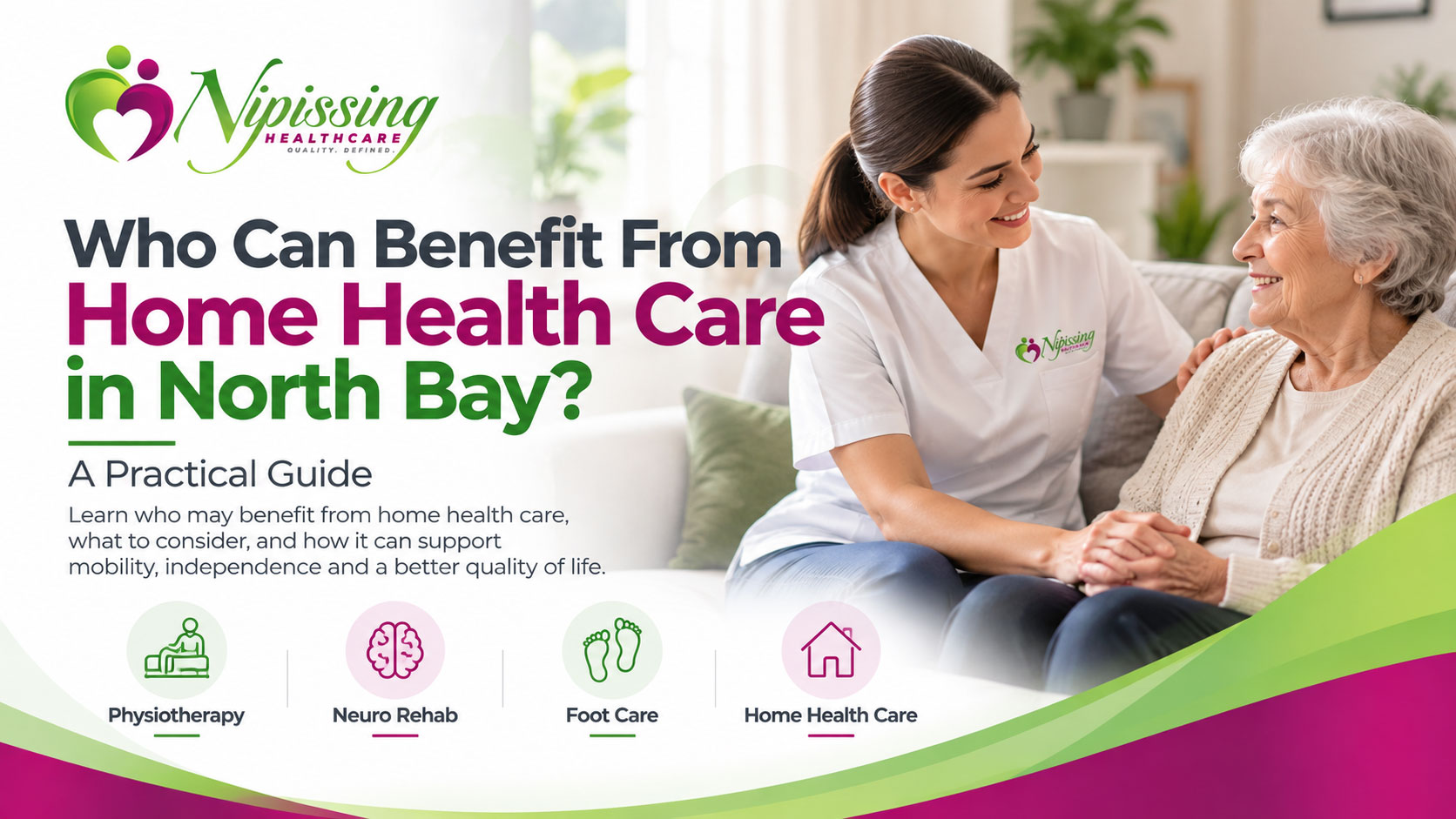
For some people, getting healthcare is not simply a matter of making an appointment and travelling to a clinic.
Pain, reduced mobility, recovery after an injury or surgery, neurological conditions, physical limitations or difficulty travelling can make accessing care outside the home more challenging.
This is where home health care may provide an important option.
Home health care allows selected healthcare services to be provided in a person’s home when appropriate, based on their individual needs and circumstances. Ontario’s home and community care system recognizes that people may require support at home for a range of reasons, including chronic conditions, disabilities, post-acute recovery and functional limitations.
At Nipissing Healthcare in North Bay, Ontario, selected in-home healthcare services are available for eligible clients who may have difficulty accessing clinic-based care. Availability depends on individual health needs and location.
⦿ Quick Answer: Who Can Benefit From Home Health Care?
☑️ Short Answer
Home health care may benefit people who need healthcare support but have difficulty accessing services outside their home because of mobility limitations, recovery needs, health conditions or other individual circumstances.
It can be particularly relevant for people who are:
- Recovering from an injury or surgery
- Experiencing reduced mobility
- Living with a neurological condition
- Having difficulty travelling to appointments
- Managing ongoing functional limitations
- Working toward greater independence at home
- Requiring selected healthcare services in their home
The appropriate service depends on the person’s health needs and circumstances.
☑️ Key Takeaway
Home health care is not simply about bringing healthcare to someone’s home. It is about providing appropriate support in an environment where the individual may be better able to access and participate in care.
Nipissing Healthcare currently describes its home health care service as a selected range of in-home services for clients unable to access the clinic, with availability based on health needs and location.
⦿ Understanding Home Health Care
☑️ What Is Home Health Care?
Home health care refers to healthcare services delivered in a person’s home when appropriate.
The exact services available depend on the provider, the person’s needs and the circumstances surrounding their care.
Ontario’s home and community care system includes services that can help people remain at home or return home following hospitalization or other healthcare needs. The province also recognizes rehabilitation and maintenance of functional status among the goals of appropriate home-based professional services.
At Nipissing Healthcare, the focus is on selected in-home healthcare services for clients who may have difficulty accessing clinic-based care.
☑️ Why Does Home Health Care Matter?
Access can be an important part of healthcare.
Someone may understand the importance of rehabilitation or ongoing healthcare support but still struggle to attend appointments because of:
- Limited mobility
- Difficulty walking
- Reduced endurance
- Recovery after surgery
- Neurological conditions
- Transportation challenges
- Physical limitations
- Difficulty leaving the home
When appropriate services can be delivered in the home, the care environment itself may become more accessible.
⦿ Who May Benefit From Home Health Care?
☑️ People With Reduced Mobility
Reduced mobility can make travelling to appointments difficult.
Someone who has difficulty walking, climbing stairs, transferring from a chair or moving safely outside the home may find clinic-based appointments more challenging.
Home-based healthcare can sometimes make accessing appropriate services easier, depending on the individual’s needs and the services available.
☑️ People Recovering After Surgery or Injury
Recovery does not always happen immediately after leaving hospital or completing a procedure.
Some people may continue to experience:
- Weakness
- Reduced mobility
- Stiffness
- Difficulty walking
- Reduced confidence
- Functional limitations
Rehabilitation may need to continue while the person gradually returns to normal activities.
Nipissing Healthcare’s physiotherapy service includes post-surgical rehabilitation, sports and injury recovery, chronic pain management, and strength and mobility restoration.
☑️ People Living With Neurological Conditions
Neurological conditions can affect movement, balance, coordination and independence.
Nipissing Healthcare’s Neuro Rehab service is designed around conditions including stroke, brain injury, multiple sclerosis and Parkinson’s disease, with rehabilitation focused on movement, balance, coordination, strength and functional independence.
For some individuals, accessing appropriate rehabilitation at home may be particularly useful when travelling to a clinic is difficult.
☑️ People Who Have Difficulty Accessing Clinic-Based Care
This is one of the clearest situations where home health care may be relevant.
Nipissing Healthcare specifically states that its selected in-home services are intended for clients who are unable to access the clinic, with availability depending on health needs and location.
This means home-based care should not be viewed as automatically necessary for everyone.
It is an option that depends on the individual’s circumstances.
⦿ The Main Question: Do You Really Need Home Health Care?
☑️ Can You Safely and Easily Travel to Your Appointments?
Consider the practical side of accessing care.
Can you:
- Leave your home safely?
- Travel to the clinic?
- Walk from the vehicle to the appointment?
- Manage stairs or uneven surfaces?
- Tolerate the journey without significant difficulty?
If travelling to appointments is becoming a significant barrier, home-based services may be worth discussing with an appropriate healthcare provider.
☑️ Is Your Condition Affecting Everyday Function?
Healthcare needs are not always measured only by symptoms.
Consider whether your condition is affecting:
- Walking
- Getting out of a chair
- Using stairs
- Moving around your home
- Completing daily activities
- Maintaining independence
- Returning to normal activities
Functional limitations can be an important part of determining whether additional support is appropriate.
☑️ Common Misconception: Home Health Care Is Only for Older Adults
Not necessarily.
Home healthcare can be relevant to people of different ages depending on their health needs and circumstances.
Ontario describes home and community care as being available to people of all ages who require appropriate support in their home, school or community.
The key consideration is need, not simply age.
⦿ What Actually Helps When Accessing Care at Home?
☑️ 1. Start With the Individual’s Needs
The first step is understanding what the person actually needs.
A home-based healthcare plan should not simply duplicate clinic care inside the home.
It should consider:
- Current mobility
- Functional limitations
- Health condition
- Recovery goals
- Home environment
- Ability to travel
- Individual priorities
☑️ 2. Consider the Home Environment
The home environment can provide important information about functional ability.
For example, a person may appear relatively mobile in a clinical environment but struggle with:
- Stairs
- Bathroom access
- Transfers
- Narrow spaces
- Moving between rooms
- Household routines
Understanding the environment can help healthcare professionals consider how care relates to everyday life.
☑️ 3. Focus on Function and Independence
Effective healthcare should connect with the activities that matter to the individual.
Depending on the person’s needs, goals may include:
- Moving around the home more safely
- Improving mobility
- Regaining strength
- Returning to normal activities
- Increasing confidence
- Maintaining independence
This is particularly relevant to rehabilitation-focused care.
☑️ 4. Choose Services Based on the Actual Problem
Home health care is not one single type of treatment.
A person may need:
Physiotherapy for movement, strength, pain or rehabilitation.
Neuro Rehab for neurological conditions affecting movement, balance and function.
Foot Care for professional foot-health needs.
Home Health Care when selected in-home services are appropriate based on individual needs and location.
Nipissing Healthcare now presents these four areas as its core service structure.
⦿Practical Guide: How to Determine Whether Home Health Care May Be Appropriate
☑️ Step 1: Identify the Main Challenge
Start by asking:
What is making healthcare difficult right now?
Is it pain?
Mobility?
Transportation?
Recovery?
A neurological condition?
Difficulty leaving the home?
The answer can help identify the appropriate type of support.
☑️ Step 2: Consider Your Ability to Access a Clinic
Think beyond simply having transportation.
Can you comfortably and safely:
- Get ready for the appointment?
- Leave your home?
- Travel?
- Walk into the clinic?
- Sit comfortably during the journey?
- Return home?
If these activities create significant difficulty, discuss whether home-based care may be appropriate.
☑️ Step 3: Identify Your Functional Goals
Your goal might be:
- Walking more comfortably
- Recovering after surgery
- Improving strength
- Improving balance
- Managing mobility limitations
- Returning to normal activities
- Remaining independent at home
Clear goals make healthcare more meaningful and measurable.
☑️ Step 4: Discuss Available Options
Home health care availability varies according to provider, location and individual circumstances.
Nipissing Healthcare states that availability of its selected in-home services depends on health needs and location.
The appropriate next step is therefore to discuss your needs rather than assuming that every service is automatically available at home.
⦿ Common Mistakes to Avoid
☑️ Mistake 1: Waiting Until Leaving Home Becomes Impossible
You do not necessarily need to wait until accessing a clinic becomes completely impossible before discussing available options.
If mobility or health changes are already creating a significant barrier, discussing appropriate care options may help clarify what support is available.
☑️ Mistake 2: Assuming Home Health Care Replaces All Clinic-Based Care
Home health care and clinic-based healthcare are not necessarily competing options.
Some people may receive certain services at home while continuing to use clinic-based care for other needs.
The appropriate setting depends on the service, condition and individual circumstances.
☑️ Mistake 3: Focusing Only on the Diagnosis
Two people with the same diagnosis may have very different functional needs.
One person may be able to travel independently.
Another may struggle to leave the home.
The person’s actual function and circumstances matter when considering care options.
☑️ Mistake 4: Choosing a Service Without Understanding the Problem
Home health care should be connected to an appropriate healthcare need.
If the primary problem is pain, mobility or rehabilitation, physiotherapy may be relevant.
If neurological symptoms are affecting movement or balance, Neuro Rehab may be appropriate.
If the concern is routine foot health, Foot Care may be the appropriate service.
⦿ Home Health Care in North Bay
☑️ Accessing Care Closer to Home
For residents of North Bay, access to appropriate healthcare can be especially important when mobility or health limitations make travelling difficult.
Nipissing Healthcare is located at 36 Lakeshore Drive, North Bay, Ontario, and provides selected in-home healthcare services for eligible clients who may have difficulty accessing clinic-based care.
☑️ A Rehabilitation-Focused Approach
Nipissing Healthcare’s overall positioning combines physiotherapy, Neuro Rehab, Foot Care and Home Health Care, with an emphasis on mobility, function, recovery and quality of life.
This creates a practical connection between healthcare delivered in the clinic and selected services delivered in the home.
The objective is not simply to provide care in a different location.
It is to make appropriate healthcare more accessible to people whose circumstances may make clinic-based care difficult.
⦿ Practical Checklist
☑️ Before You Start
Consider:
- What healthcare support do I need?
- What makes travelling to a clinic difficult?
- How is my condition affecting everyday activities?
- Can I safely leave home?
- What are my main recovery or mobility goals?
- Would home-based care make access easier?
☑️ During the Process
Keep track of:
- Changes in mobility
- Ability to complete everyday activities
- Pain or discomfort
- Strength
- Balance
- Independence
- Progress toward your goals
Share meaningful changes with your healthcare professional.
☑️ Measuring Progress
Progress can look different for every person.
It may include:
- Moving around the home more easily
- Walking more comfortably
- Improving strength
- Completing daily activities with less difficulty
- Increasing confidence
- Returning to normal routines
- Maintaining greater independence
⦿ When Professional Help Makes Sense
☑️ Why Expertise Matters
It can be difficult to determine which type of healthcare support is appropriate based only on symptoms.
A person experiencing difficulty walking may have a musculoskeletal problem, a neurological condition, reduced strength, balance limitations or another contributing factor.
Professional assessment helps place the symptoms in context.
☑️ When Personalised Support Is Useful
Personalized support may be particularly useful when:
- Mobility has declined
- Recovery is taking longer than expected
- Travelling to a clinic is difficult
- A neurological condition affects movement
- Everyday activities have become harder
- You are recovering from an injury or surgery
- You need support maintaining function at home
Nipissing Healthcare provides Physiotherapy, Neuro Rehab, Foot Care and selected Home Health Care services in North Bay, allowing the appropriate service to be considered according to the individual’s needs.
⦿ Conclusion
Home health care can be an important option for people who need healthcare support but face challenges accessing clinic-based services.
Reduced mobility, recovery after injury or surgery, neurological conditions and other functional limitations can make travelling for appointments difficult.
The important question is not simply whether someone needs “care at home.”
It is what type of healthcare support they need, whether it can appropriately be provided at home, and whether home-based care would improve access to that support.
For people in North Bay, Nipissing Healthcare provides four core service areas:
Physiotherapy
Neuro Rehab
Foot Care
Home Health Care
with selected in-home services available based on individual health needs and location.
☑️ Looking for Home Health Care in North Bay?
If mobility, recovery or other health-related circumstances are making clinic visits difficult, discuss your needs with Nipissing Healthcare.
Our services include:
Physiotherapy | Neuro Rehab | Foot Care | Home Health Care
Nipissing Healthcare
36 Lakeshore Drive
North Bay, Ontario
705-667-1781
Contact Nipissing Healthcare to discuss your healthcare needs and whether selected in-home services may be appropriate for you.
Why Everyday Movements Become Harder With Age
How Neuro Rehabilitation Helps Restore Movement and Independence